Top 10 RAG Interview Questions Answered
Complete answers to the most asked RAG interview questions. Covers retrieval, chunking, embeddings, reranking and evaluation. Perfect for AI Engineer and Data Scientist interviews.
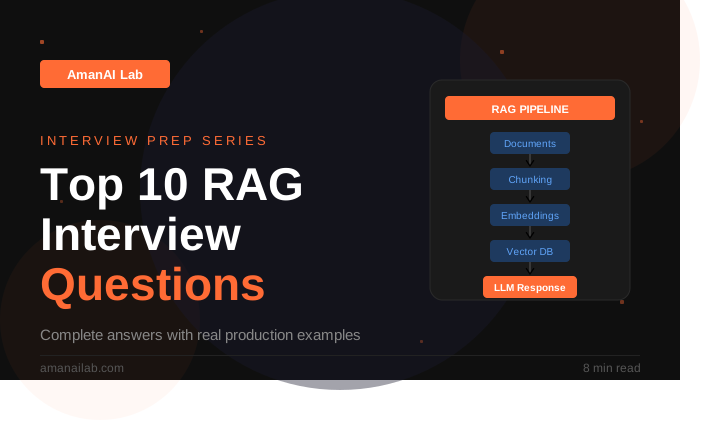
RAG or Retrieval Augmented Generation is
one of the most important topics in AI
interviews today. Every company building
AI products uses RAG. Here are the top 10
questions you will face and exactly how
to answer them.
1. What is RAG and why is it used?
RAG combines information retrieval with
LLM generation. Instead of relying on
training data alone, RAG fetches relevant
documents at query time and provides them
as context to the LLM.
Why it matters:
Reduces hallucination significantly
Keeps information current without retraining
Allows LLMs to reference specific documents
Much cheaper than fine-tuning for knowledge
2. Explain the RAG pipeline end to end.
A complete RAG pipeline has 6 steps:
Document ingestion - load PDFs, docs, web pages
Chunking - split into 256-512 token pieces
Embedding - convert chunks to vectors
Storage - save vectors in vector database
Retrieval - embed query, find similar chunks
Generation - pass chunks as context to LLM
3. What chunking strategy do you recommend?
This depends on the content type.
For general documents use recursive
character splitting with 512 tokens and
50 token overlap. This is the LangChain
default and works well for most cases.
For long technical documents use
semantic chunking which splits on meaning
boundaries rather than character count.
For Q&A datasets use parent-child chunking
where small chunks are retrieved but the
parent chunk is passed to the LLM for
more context.
4. What is the difference between dense
and sparse retrieval?
Dense retrieval uses semantic vector
similarity. It understands meaning so
similar meaning queries find relevant
results even with different words.
Sparse retrieval uses BM25 keyword
matching. It is exact match based and
works better for specific terms, names
and technical jargon.
Hybrid search combines both and gives
the best results in production. Use
alpha of 0.7 dense and 0.3 sparse as
a starting point.
5. How do you improve RAG retrieval quality?
Five techniques that actually work in
production:
Query expansion - generate multiple
versions of the query before retrievalHyDE - generate a hypothetical answer
and embed that instead of the raw queryReranking - use Cohere Rerank or
FlashRank to reorder retrieved chunksHybrid search - combine dense and
sparse retrievalParent-child chunks - retrieve small
chunks but pass larger context to LLM
6. What embedding model do you recommend?
For production with budget use
text-embedding-3-small from OpenAI.
It is fast, cheap and very good quality.
For open source use BAAI/bge-large-en-v1.5.
It is the best open source English
embedding model.
For multilingual use Cohere
embed-multilingual-v3.
Always benchmark on your specific data
before choosing. General benchmarks do
not always match your use case.
7. What is reranking and when should you use it?
Reranking is a second pass scoring of
retrieved documents using a more powerful
cross-encoder model. Vector search returns
semantically similar documents but not
always the most relevant ones.
A cross-encoder like Cohere Rerank reads
both the query and each document together
and gives a relevance score. This is much
more accurate than vector similarity alone.
Always use reranking when answer quality
matters more than speed. It adds 100-200ms
latency but significantly improves answers.
8. How do you evaluate a RAG system?
Use the RAGAS framework with these metrics:
Faithfulness - is the answer grounded in
the retrieved context? Score 0 to 1.
Answer Relevance - does the answer
actually address the question? Score 0 to 1.
Context Recall - did retrieval find all
the relevant information? Score 0 to 1.
Context Precision - are the retrieved
chunks actually relevant? Score 0 to 1.
A production RAG system should target
above 0.8 on all four metrics.
9. What is the lost in the middle problem?
LLMs pay more attention to content at
the start and end of their context window.
Information in the middle gets ignored.
This matters for RAG because if you
retrieve 10 chunks the most relevant
ones should be first and last not buried
in the middle.
Solution: after reranking place the
highest scored chunk first, second highest
last and fill the middle with lower
scored chunks.
10. When would you use fine-tuning
instead of RAG?
Use RAG when:
Knowledge changes frequently
You need to cite sources
You have a large document collection
Budget is limited
Use fine-tuning when:
You need specific output format or style
Domain vocabulary is very specialized
Latency requirements are very strict
Knowledge is stable and does not change
In most production cases start with RAG.
Add fine-tuning only if RAG cannot achieve
the required quality.
Conclusion
RAG is essential knowledge for any AI
engineering role. Master these 10 concepts
and you will be prepared for most RAG
interview questions.
Practice building a RAG system from
scratch using LangChain and Qdrant.
Hands-on experience is what separates
good candidates from great ones.
Download our free RAG Complete Guide
cheat sheet at amanailab.com/resourcesfor a quick reference during interview prep.
Enjoyed this article?
Join 500+ AI developers getting weekly tips, news and resources from AmanAI Lab.
No spam. Unsubscribe anytime.
Discussion
Sign in to comment →Join the discussion
Sign in with your AmanAI Lab account — it takes 30 seconds.